
Welcome to the Wheelhouse, a series of blogs from Ebiquity’s Marketing Effectiveness team.
In the latest edition of The Wheelhouse, Tom Loughnan, Director of Analytics, recommends eight tools and techniques to elevate marketing effectiveness above the marketing sandpit and build credibility across client businesses, not just in the marketing department. Tom’s eight-point action plan is designed to make marketing effectiveness a key driver of better business performance.
“So, what do YOU do?”
One of the most frequently-asked questions when you meet someone for the first time is “So, what do you do for work?” And if, like me, you work in marketing effectiveness, you face the unenviable task of trying to explain something very niche and specialised in a few, short sentences to someone who – at best – is only a little bit interested. There’s a very limited window before they glaze over and move on to talk to someone more interesting instead.
In a nutshell, the job is designed to measure the impact that advertising and marketing inputs have on business outcomes, usually on sales. It’s gratifying that this summary is met more often than you’d think with surprise and a follow-on question: “Oh, that’s actually quite interesting! How do you prove advertising works?”
This is a crucial question and it plays a central role in how much a business buys into a culture of marketing effectiveness. Proving how or that advertising works is difficult. Many of the techniques employed in marketing effectiveness are complex. And yet, like explaining your job to a stranger, the explanation to business stakeholders must be simple and clear.
This doesn’t mean, however, that you omit all the detail. Detail is every bit as critical as simplicity. The challenge lies in navigating the stakeholder set-up within a business and presenting the relevant proof and detail to the appropriate people. It’s all about knowing your audience and appreciating their likely tolerance for data and need for detail.
The dramatis personae of business stakeholders
In a purposefully-reductive paradigm of consumer brands, here are three, broad archetypes of internal stakeholders that we marketing effectiveness practitioners often encounter.
- Archetype 1: The Persuaded – Marketing. Marketers believe that advertising drives sales. If they didn’t, they’d have picked a curious career path.
- Archetype 2: The Sceptical – Commercial, Finance, and the C-suite. This cohort is on the whole more sceptical about the impact that advertising can have on business KPIs. They might think that advertising has some impact, but they also believe that attribution methods can overstate its importance.
- Archetype 3: The On-the-fence – Insights and Data Science. This cluster tends to be detail-oriented and members don’t automatically adopt the role of friend or foe. They often have very specialised knowledge of specific areas of the business and can identify if datasets or insights are being understood and implemented correctly.
Horses for courses
All groups want detail, and marketers in particular crave ever-greater detail of genuine, data-driven insights and recommendations. They may be pre-disposed to believe that advertising drives sales, but that doesn’t mean that they don’t need supporting evidence.
Commercial and finance types are less concerned by the nuance of Instagram vs Youtube ROI, but they will challenge you to substantiate top-line claims of an analysis, such as the overall incremental value of advertising. They crave confidence in the total media ROI that you present as a top-line summary. Credibility is everything. If you can’t lead the room and build trust in the analytics, then there’s almost no point in doing the work in the first place. Although your key stakeholders are probably in the marketing department, engaging the commercial and finance community is essential if the work is going to have any traction.
Given that decision-making typically goes hand-in-hand with seniority, it can be tempting to aim straight for the C-suite to have maximum impact. In a lot of businesses, however, there are other, influential gatekeepers you also need to bear in mind. These are often individuals who aren’t necessarily the final decision-maker, but they’ve been in the business for some years, they’ve built up their own stockpile of credit, and their opinion is highly regarded by the top brass. Never bypass these gatekeepers. Seek them out, spend time with them, and build your credibility with them before rushing on up the greasy pole. An endorsement from a critical gatekeeper can be vital when it comes to building credibility within the business.
8 ways to build credibility for marketing effectiveness
There’s no one-size-fits-all approach when it comes to building confidence in our business-critical function among client stakeholders. That said, there are some general guidelines that are helpful if you want to build credibility in marketing effectiveness and bridge the gap between marketing and non-marketing communities, reassuring all three archetypes characterised above. Here are eight.
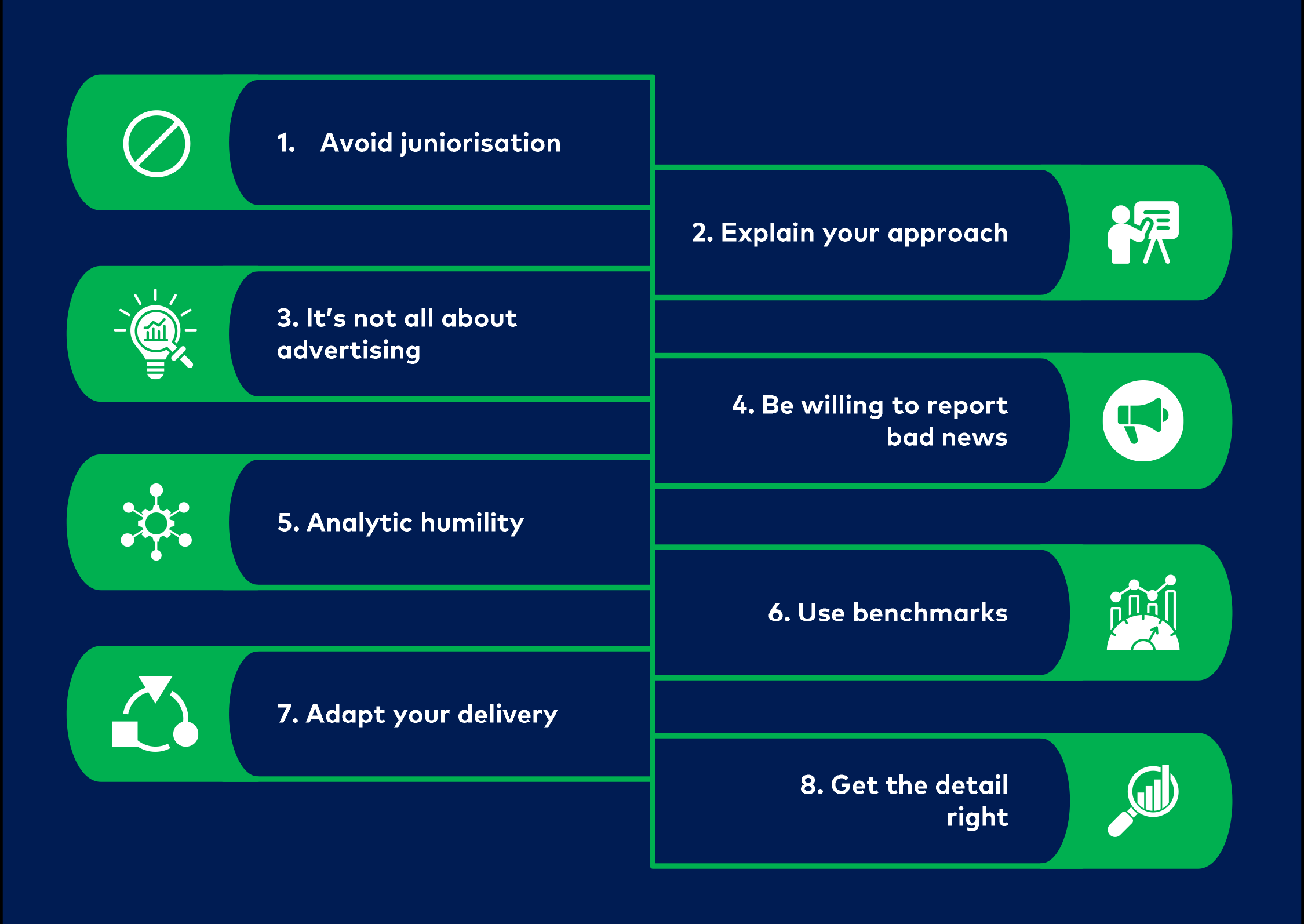
- Avoid juniorisation. Clients will notice and your credibility will suffer. Experienced analysts add more value to the decision-makers when they get close to the coalface.
- Explain your approach. Get buy-in from key gatekeepers before giving results to wider communities of stakeholders.
- It’s not all about advertising. The main reason that Marketing Mix Modelling (MMM) results are not trusted is the often-widespread suspicion that sales are attributed to advertising incorrectly and have actually been driven by something else. Provide insight on issues non-marketers care about, including discounting, estate, credit and so on.
- Be willing to report bad news. Sceptics are rarely convinced by wave after wave of positive advertising results. A bad result leads to trickier conversations, but if it leads to an enlightening strategy recommendation, it will ultimately be viewed positively.
- Analytic humility. Being open about the limitations, drawbacks, and blind spots of a measurement framework will often go much further than bluster and over-reaching claims of reliability and robustness.
- Use benchmarks. Demonstrating that you’ve seen this all before is often reassuring and gives the underlying story more clout.
- Adapt your delivery. Again, this is all about knowing your audience. A two-page pre-read might be better than a set of slides for some senior executives. A screenshot embedded in the body of an email might get more traction than an attachment.
- Get the detail right. If you start a presentation and your sales figures or marketing budget don’t match the numbers everyone in the business subscribes to, then you’ve just opened your credibility account with a negative balance.
As a general point, it is worth noting that credibility is much easier to establish if your marketing effectiveness programme is delivered by an independent specialist. There is much to consider in this space however, and this is explored in my colleague Ryan Rooney’s post in The Wheelhouse blog series earlier this year, titled “Insourced, outsourced or hybrid? What’s the best model for marketing effectiveness?”
Summing up
The purpose of conducting any analysis is to provide an objective perspective and use it to inform and influence decision-making. You can have the most outstanding modelling platform and the most robust estimation techniques, but if you can’t build credibility, the value of the analytics is precisely zero because it will stay stuck in spreadsheets and PDFs that no one bothers to open or reference.
The specific methodologies chosen and deployed are incredibly important and will be put under scrutiny, but marketing effectiveness advisors still operate in a social context. This means that your approach is only as good as the individuals who deliver the insights and interpretations, in the consultants who take the client on the journey from “So what?” (this is what the data mean) to “Now what?” (this is what we recommend you should do as a result). Credibility, here, is everything.
Ultimately, the most important advice is to get to know and understand your stakeholders – their motivations, their ‘hot buttons’, and their data tolerance. Personal relationships are critical, and the person delivering the insight is as important as the insight itself – if not more so. That’s why it’s vital for marketing effectiveness practitioners to ask smart questions and quickly discover what it is that’s going to build credibility for the stakeholders that matter. The eight-point checklist above can help, but the drivers of credibility with your specific clients might be totally different.
When building credibility among the commercial and finance community, it’s important not to frame them as adversaries, as this will simply manifest as “us versus them”. Consider that they simply present a different perspective. The best analytics demonstrates objectivity so that all groups can focus on the collective goals of the business.
Feel free to get in touch with the Ebiquity team to further discuss these important updates and take proactive steps to reduce wasteful practices. Reach out now.