


Making sense of marketing impact
Marketing Mix Modelling (MMM) is becoming increasingly difficult to navigate. Many organisations are finding it ever-more challenging to wrap their minds around this business-critical discipline. This is particularly true for procurement teams.
It used to be that MMM was a powerful analytical technique used to assess how a business’s marketing investment affected sales. Brands and their advisers used the approach to understand the client’s marketing plans – often focused on media choices – and then create a line of sight to the sales impact and the efficiency of these investments.
Separating the gold from the fluff
Now in 2026 when I look at the claims and counterclaims made in the marketing press and on MMM providers’ websites, I am increasingly bemused at some of the assertions being made. For instance, one prominent provider has branded its offering as ‘MMM 2.0’, but the itemised capabilities of their product suite show it’s no more than what all good MMM has always been. We’ve moved from a time when vendors talked simply about how they interpret marketing and messaging to the current situation where advertisers must cut through the sales shpiel and ask questions as stark as “Is this true, relevant or important?”.
“Double maths on a Friday morning”
More than ten years ago, I was invited to speak at a World Federation of Advertisers (WFA) meeting on the topic of “Why are Marketers so often let down by Marketing Mix Modelling?”. My first thought was “Thanks a lot!”; there had been a survey of WFA members, and the title of the talk had been chosen to reflect the results of their poll.
The main issue was that there was a clear disconnect between the MMM agencies and their clients, with clients believing agencies were not commercially savvy and hiding behind technical language. Some clients were clearly very happy with their results and the guidance they received, having developed a great marketing effectiveness culture within their organisations. But this was by no means true for all or even most of them.
The causal factors behind this dissatisfaction stemmed from the level of consultancy support provided by the agencies. I have often heard MMM being described as “double maths on a Friday morning” (hardly a ringing endorsement or likely to get the CFO or CEO to pay attention), and the term a “black box model” has too-often been used to describe MMM.
How to make MMM work for your business
It’s vital that MMM agency partners demystify the black box and are totally transparent in how data is used in the models they produce. The critical word is trust. For example, MMM advice needs to come from a source independent of media buying.
To make MMM work for your organisation, I believe there are four things that clients need to do.
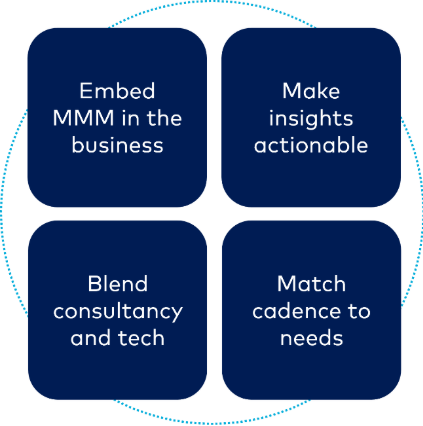
1. Embed MMM in the business
MMM should be positioned as a results-driven discipline within the business, involving senior stakeholders and functions well beyond marketing, particularly finance. Good MMM models will assess the impact of all factors affecting the client’s business performance – from the economy to pricing, from distribution to media, from global headwinds to the behaviour of the competition. Done and explained right, MMM matters to everyone.
2. Make your insights actionable
The results of MMM need to make sense to the business, yet all too often the results generated by MMM models conflict with advice given by media planning agencies. Results need clear explanation and context. The sales impact of media is in part a function of the reach and cost of media deployed, with ROI from media defined as “incremental sales/profit generated, divided by media cost”.
Not all media channels are created equal, both in terms of reach and attention attained in consumers’ minds. Complementary data sets of advertising verification and digital governance are particularly useful. For instance, I have never seen “off inventory” digital media buys – where an advertiser has bought opaque digital inventory packages at low cost – deliver positive results via MMM.
3. Blend consultancy and tech
Great advisory coupled with cutting-edge technology is a winning combination in the MMM industry. It’s vital to have both strong MMM results delivery tools as well as effective media optimisation tools to plan future media budgets. Indeed, in the last ten years, these have become table stakes for leading econometrics advisers.
At Ebiquity, we often say that a good MMM programme is 50% maths and 50% interpretation, with analytics set in their proper context through knowledge of both commercials and the evolving media landscape. Trust developed in MMM – by your partner’s ability to contextualise and interpret the findings – will always trump any technology that sits on top. If your advisors can’t explain the model and its findings clearly and simply, no-one will accept the results.
4. Match cadence to needs
How often you receive results and guidance from your MMM partners needs to dovetail with your commercial needs. Don’t allow the timetable to be set by what works for your agency partners or what their econometric tools can produce.
Digital attribution techniques were, in my view, the biggest measurement crime over the last 20 years. While this approach has significant, widely-accepted flaws, the marketing industry has got used to a high cadence of marketing effectiveness reporting.
Therefore, there’s a perceived need for high-frequency modelling. For busy, multi-layered media plans, a higher frequency of monthly MMM reporting can often be sensible. For others, quarterly, half-yearly or even annual cadence provides enough insight into what drives outcomes. So, as ever in advertising, there are no absolutes. Higher cadence reporting can be valuable, but it does add cost which might outweigh the additional benefit.
Summing up
Dialling the clock forward ten years from my WFA address to today, the issues from that survey are still very much in evidence. In fact, I’d argue that the situation is worse in some cases.
MMM done well is hugely powerful. You should expect to increase the ROI of your media budget by at least 20% if you work with a competent partner. There’s a lot of marketing fluff and misguided product information in the MMM marketplace, so do your research well. And if you follow our four, golden rules, you’ll make MMM work for your business.