

Four point three billion. That’s the number of minutes of streaming TV content consumed globally in just 12 minutes. The number represents both an enormous opportunity and, frankly, a massive problem we’re ignoring as an industry.
Here’s my controversial take: we are currently approaching streaming TV as if it’s digital banner ads. And it’s not. Streaming is television, and it deserves television thinking.
The evolution we forgot to make
Back in 2006, when Channel 4 launched its on-demand service, I’d just learned what a TVR was. Suddenly, we had new metrics to grasp and an entirely new ecosystem to navigate. What was inspiring about that moment was how quickly the industry evolved. TV teams became AV teams almost overnight. We adapted.
Fast forward to 2025. Consumers have quality content at their fingertips across hundreds of channels, whenever and wherever they want. But from a buying and planning perspective, the ecosystem has become extraordinarily complex. Multiple DSPs, countless verification partners, the intricate plumbing of distribution, constant evolution with FAST channels launching and platforms building their own ad tech.
Yet we haven’t made that same evolutionary leap. Your streaming TV investments are being fragmented across digital teams, programmatic teams, and traditional TV teams. That fragmentation is causing misalignment and, ultimately, waste.
Explosive growth demands better standards
Every market is at a different stage in its streaming TV journey, from advanced to emerging. But they share three things: complexity, challenges, and explosive growth.
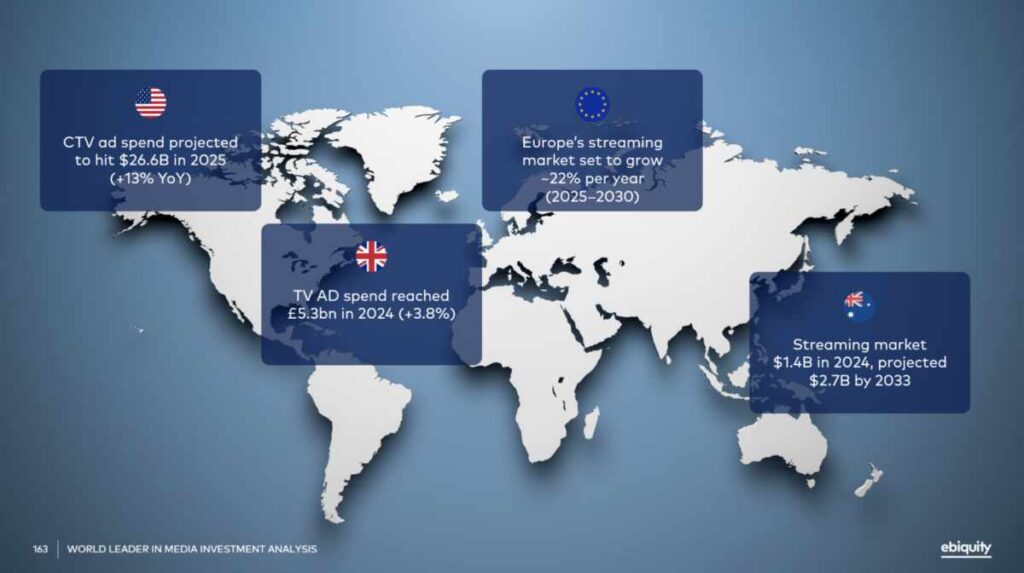
In the US, connected TV ad spend is projected to hit $26.6 billion this year, up 13% year-on-year. Here in the UK, total TV ad spend reached £5.3 billion in 2024, a 4% increase driven by streaming channels. Europe’s streaming market is set to grow approximately 22% per year through 2030. Australia’s streaming market, worth $1.4 billion in 2024, is projected to hit $2.7 billion by 2033.
These aren’t small numbers. And yet, despite billions in investment, we’re not applying the quality standards that should come with television-level spending.
The critical truth: not all streaming is equal
At Ebiquity, we’ve analysed over a billion dollars of streaming ad spend in the past year alone. What that analysis revealed is uncomfortable but essential: qualitative criteria determine the success or failure of your streaming TV investments. Those criteria are content, screen size, and environment.
Let’s talk about environment, because there’s a significant gap between perception and reality, particularly around frequency.
The frequency problem
Here’s what we’re told: frequency is controlled and capped. You won’t see repeated ads in one session. We’re in 2025, ad tech prevents duplication.
In reality, we’ve been logging viewing sessions across the UK, and in over 50% of sessions, we’ve found repeated ads. Not just twice or three times. The average frequency in a single session is 1.5x, not the 1x your CPMs represent.
A study by Innovid earlier this year found that 8-15% of households were over-served versus the intended cap. That might sound manageable until you realise that 42-60% of impressions were delivered to those over-served households.
This matters because we know from the Advertising Association’s trust research that frequency or bombardment is the number one driver of advertising mistrust. There was a comment I saw in a consumer forum that stayed with me: “The only thing I want to do after seeing the same ad six times is never buy that product.”
That’s a negative impression. And we don’t talk about negative impressions nearly enough.
Ad load variation
Then there’s ad load, and minutes really do matter.
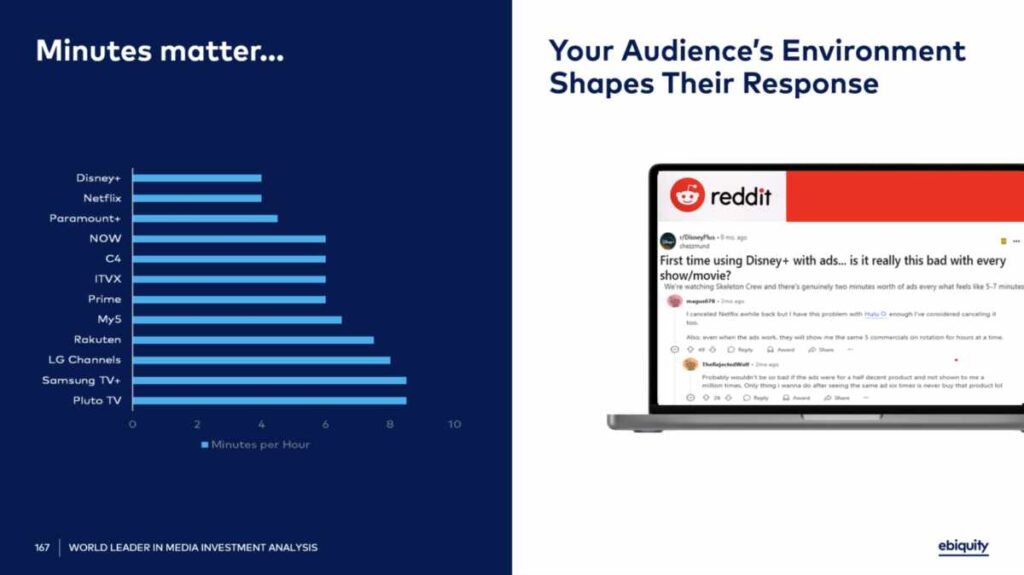
The SVODs like Netflix are committed to four minutes of ads per hour to maintain that premium environment and prevent churn. Broadcasters are mirroring linear, which consumers are accustomed to. But FAST channels? That’s where you find significantly more clutter. And yes, this does impact audience response.
Content quality and screen size
Through our marketing effectiveness team’s profitability research, we know content quality and screen size drive profitable growth. The fundamental challenge is that this area isn’t being properly defined in streaming plans.
We’re seeing a spectrum of platforms on advertiser plans. Premium TV content on predominantly large screens, which we know pays back. But we’re also seeing questionable content on small screens at CPMs more expensive than the premium inventory.
From your perspective as an advertiser, you need to know where your brand is being seen. Is your vision and perception matching reality? Do your agency partners know where you want your brand positioned?
I’m seeing gym TVs on streaming plans. That’s not TV quality content. That’s out-of-home being sold with streaming TV price tags.
The structural problem
The root cause is legacy structures. Digital teams and traditional TV teams working in silos has created a grey area where streaming lives, and it’s driving wasted investment.
The evolution from separate teams to unified video planning needs to accelerate. The industry successfully made this transition in 2006, and we need to make it again now.
The four-point framework for streaming success
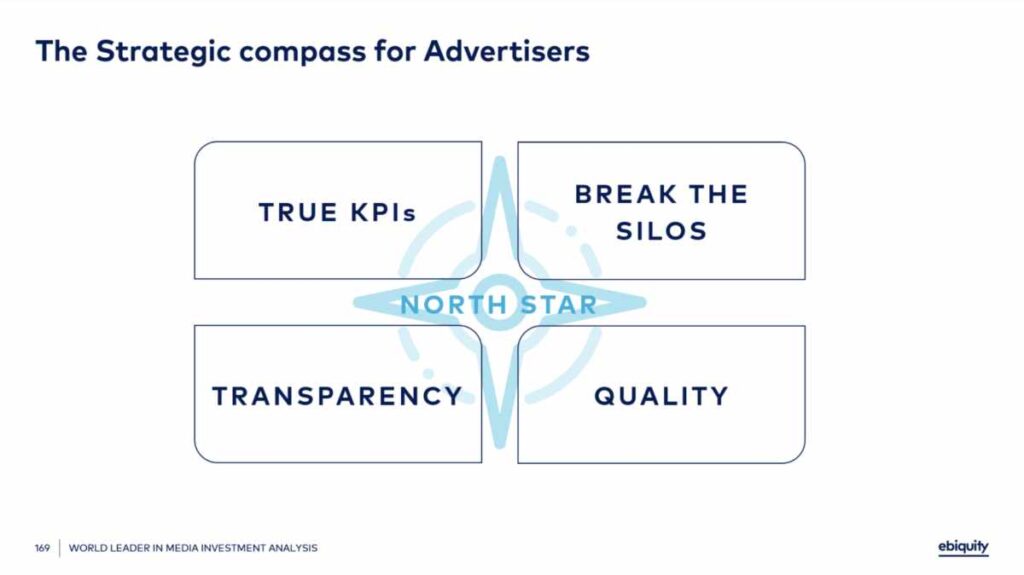
This space is incredible and can absolutely deliver profitable growth. But it requires four fundamental shifts:
- Define true KPIs beyond delivered impressions and view-through rates
- Unify video teams to approach streaming TV holistically together
- Demand granular transparency on inventory partners and ad placement
- Make quality your north star for all streaming investments
Without guardrails your investments are at risk. I’ve seen clients with approved exchange whitelists who didn’t understand the underlying inventory partners on those exchanges. The result? Expensive duplication and quality degradation.
The opportunity ahead
Those 4.3 billion minutes I mentioned at the start represent opportunity. Streaming is dominant, and its acceleration is unstoppable. But success belongs to those who approach it smartly.
My ask is simple: stop categorising streaming TV as digital. It’s not. Have that conversation with your partners about how to approach this space. Challenge the plans. Understand your brand positioning and where you want to be seen. Ensure you have a measurement framework of KPIs and best practices that drives those success levers.
The streaming TV era is here. Let’s treat it with the standards it deserves.