
Welcome to the Wheelhouse, a new series of blogs from Ebiquity’s Marketing Effectiveness team.
Priya Patel, Group Director at Ebiquity, recently took part in Marketing Week’s Currency of Effectiveness “What Works” session, and one of the big topics was the continued relevance of the JPJ curve. Does it still hold up today?
For those of you not familiar with the JPJ curve, back in 1987, John Phillip Jones (JPJ) published a major, landmark study. Focused mostly on FMCG brands, the study analysed the relationship between Share of Market (SOM) and Share of Voice (SOV). More specifically, it calculated excess Share of Voice, which is the difference between a brand’s share of voice and what you would expect based on its share of market.
Jones found that those brands investing more than their fair share did, on average, see an increase in growth over the longer term. He gave three reasons why this should be the case.
- Smaller, challenger brands require over investment in order to compete.
- Established brands are ‘profit takers’ – cash cows that are profitably being run down.
- Advertising economies of scale. Big brands can get sufficient reach at reasonable reinvestment rates. Spending in line with market share delivers no more than excess frequency and yields only diminishing returns for a big brand.
The pattern first identified by JPJ seems to stand today. When brand consultant and former marketing professor Mark Ritson analysed several thousand Effie entries, he came to the same conclusion.
As marketing effectiveness practitioners at Ebiquity, we buy into this reasoning – not least because we see the same pattern with the brands we count as our clients. When they invest more, they grow; when they invest less, they shrink. What is becoming more challenging, however, is obtaining accurate data to measure a baseline share of voice in the first place.
Back in 1987, almost all FMCG spend was on TV, and obtaining competitor ratings was straightforward. Modern media plans are very much more fragmented. Because of online media, simply getting a read on a competitor’s adspend has become a minefield.
If we had to dispute the JPJ curve in this more complicated market, it would probably be on the basis that SOV on its own isn’t really enough; what you really need to calculate is effective share of voice. Time and again, we see a lot of contemporary marketing investment that just doesn’t move the needle on sales. Lower attention, weaker creative, or a suboptimal media mix impair return on investment.
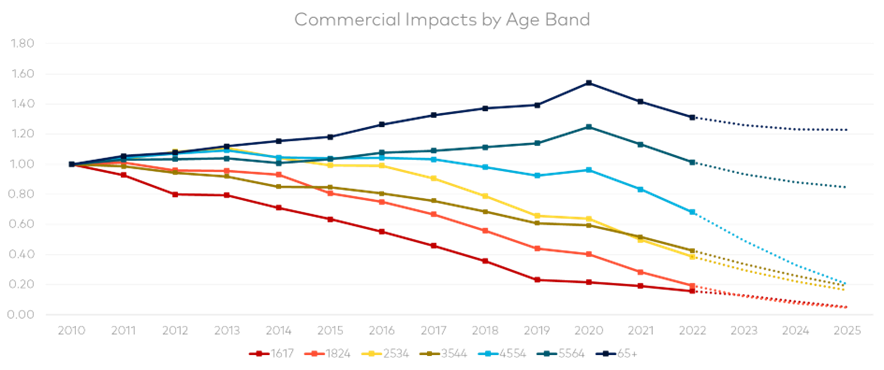
Finding an effective substitute for linear TV on the media plan is probably the biggest challenge that many of our clients are facing right now. With the continuing decline in commercial impacts for most audiences – starkly evidenced in the chart below – it has become essential for brands to re-optimise their media mix.
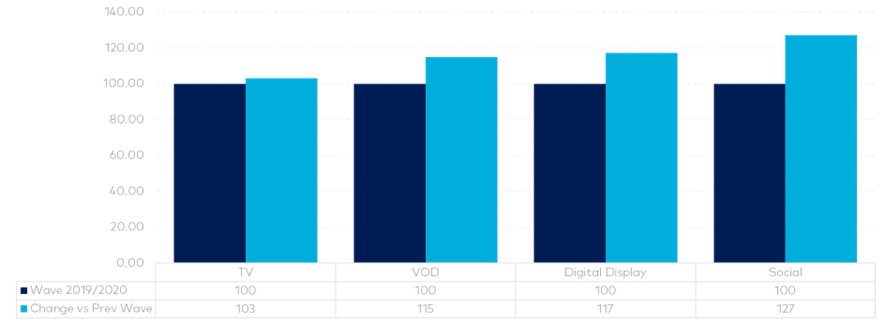
It isn’t all bad news, however, and the most recent benchmarks created by Ebiquity have shown that, despite losing younger viewers, TV ROI is surprisingly resilient. Other AV channels including YouTube, broadcast VOD, and connected TV are also catching up with the impacts provided historically only by linear TV and, as a result, are offering better returns.
It is our experience that share of voice is important, but it’s not the most important thing. Brands should focus on the effectiveness of their share of voice. Getting the product, the creative, and media mix right is the first step. Do that, and the impact can be measured credibly. With a little luck in the boardroom, this approach should drive increases in both sales growth and supporting marketing budget. That’s why the JPJ curve is still relevant.
Priya Patel is a Group Director at Ebiquity, the independent, world leader in media investment analysis. She has worked in the company’s Marketing Effectiveness team since 2006. With a breath of experience across all sectors, Priya’s goal is always to improve the effectiveness of media. In March 2023, she spoke at Marketing Week’s “Currency of Effectiveness” Festival.